
Understanding the Power Imbalance
The therapeutic relationship between a therapist and a client is inherently unbalanced in terms of power. The client can give their power away to the therapist; the therapist’s challenge is to then find a way to give that power back to the client to empower him/herself. You can not discuss a course based on ethics without discussing the power differential in therapeutic relationships, as this is where many malpractice cases can stem from.
‘Obviously therapy is powerful, therapists can be powerful,’ says Totton. ‘It’s up to us to find ways of giving that power back to our client. But there’s no form of administrative solution that will make that happen. The wish to not have power over the client has to come from deep within the therapist.’ (Pointon, 2007)
Types of power in the therapeutic relationship
1) Professional Power. The first perspective involves the asymmetry inherent in a professional relationship. The clinician has extensive information about the patient; the patient lacks similar data about the clinician. The therapist is paid to see the patient, keeps a medical record, and in most cases has more extensive psychological knowledge.
This kind of power asymmetry involves overt, observable factors. Power themes arising from the explicit power operations named above would include: reporting to child services, involuntary hospitalisation, assigning a diagnosis, and so on. So would more subtle, often mutual understandings of the clinician’s greater authority by virtue of their training (Fors, 2021).
2) Transferential Power. A second way, and a common one, of conceptualising power in psychotherapy concerns the implications of the transference and other unconscious parts of the therapeutic relationship. This is when a client can project specific roles onto the practitioner, potentially leading to an interdependency between therapist and client. The relational perspective appreciates transference phenomena but construes power as issuing from unconscious shared dynamics and the emotional interdependency of patient and therapist (Fors, 2021).
3) Socio-Political Power. The third perspective on power in psychotherapy includes extensive and heterogenous phenomena. In this domain are various issues of external social power as they enter the therapeutic space. It includes, for example, attention to how gender, social class, and overall social norms affect the therapeutic relationship (Fors, 2021).
4) Bureaucratic Power. The fourth common perspective on power in psychotherapy involves bureaucratic aspects of access to care. Subordinated groups are often at a relative disadvantage in obtaining treatment or social benefits (Fors, 2021).
Exploring the power dynamics in the therapeutic relationship
When seeking help, people often give their power away to others seeking answers outside of themselves. This often results in a greater than ordinary vulnerability and leads people to be more susceptible to being harmed through the misuse of power and influence. If people do not trust themselves, often they will be looking for someone else to take on that responsibility for them so that they do not need to make decisions on their own. This is where they can give their power away to others and become overly trusting in people, leading to poor choices in life.
No one can take anyone’s power away from them, and it is a complete pseudoscience to say that it is possible to brainwash someone. Often, the term ‘brainwashed’ is used only when someone disagrees with another’s values; it dehumanises people by denying their free will. It is an individual’s choice to give their power away to another; often, this is the result of feeling powerless from experiencing abuse throughout their life or from when they have made choices in life that have not worked out well, so they no longer trust their ability to make decisions.
Being able to empower clients not to give their power away starts with the therapist’s innate desire not to be identified or over-inflated by it in the first place. Suppose there is any part of you that enjoys having power over a client. In that case, it can create a dependent relationship where the client seeks answers, uses fawning behaviours, looks for advice and becomes dependent on the therapist. Often, therapists are just as, if not more, vulnerable than their clients and are dealing with issues in their personal lives, which is entirely common. This does not mean that the therapist is any less capable, but it does mean that they need to be aware of themselves and any part of them that is looking for an ego boost in a counselling session.
If the practitioner is feeling insecure in their own life or professional capacity, then they may enjoy the feeling of having power in a relationship. Sometimes clients who give their power away are very complimentary and likeable people. They give you praise, are very attentive in sessions and seek your approval and guidance for life decisions. They can sometimes be the ‘easy clients’ that form a dependable source of income. This can lead to over-servicing of clients, boundary violations, and a whole myriad of other ethical problems. Some ways to support giving the power back to the client can include:
- Avoiding technical jargon that merely serves to reinforce the client’s position of inferiority.
- Misunderstanding your elevated role power as confirmation of your wisdom and a mandate to take charge, you may inadvertently disempower, disregard, or disrespect the people who turn to you for help.
- The seating arrangements and therapeutic space can be arranged in such a way that promotes an even playing field. E.g., open space, not sitting behind a desk or in an elevated position.
- The therapist should also avoid any personal or sexual relationship with the client as it risks putting both of them in a compromising situation.
- Avoid self-disclosure and becoming too familiar with the client; you want to dissolve the power imbalance but not the professional relationship (it is a fine line). However, it is very rare for the power imbalance to be completely dissolved.
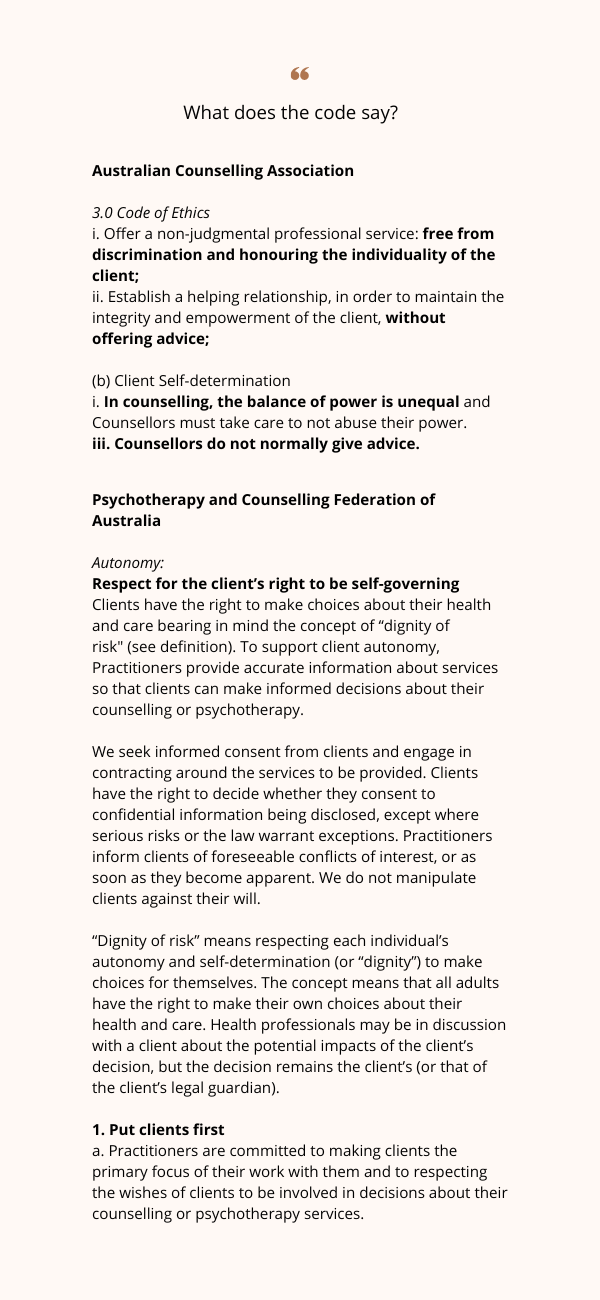
- Do not give advice (it is directly against the CoE to do so)
- If the client is seeking answers or reassurance, address this in the therapeutic relationship and support them to find the answers within themselves rather than giving the answers to them
- Not being invested in outcomes and trying to direct the client on the road that you think they should go down rather than supporting them to find their own direction
- Being self aware and reflecting on your role in maintaining the imbalance and always asking yourself ‘who is it that my actions are serving here’ as in, am I serving the client and their best interests? Or am I serving my ego and my bank account.
- Always reflecting on any arrogance that may arise in you, an ‘I know best’ attitude or frustration with the client for not doing what you want. The client is always an equal in the relationship and should never be seen as less wise or unknowing.
- Know one must heal themselves and you are but a guide on their journey, you are not the reason or cause of their healing or heartbreak.
There are some benefits of the innate power imbalance
In summary, the power imbalance in therapeutic relationships is a critical issue that must be addressed by therapists. Empowering clients to make their own decisions and trust their own abilities is essential to successful therapy. Therapists must be aware of their own biases and the potential for power dynamics to arise in their relationships with clients. By avoiding technical jargon, taking responsibility for misunderstandings, arranging seating and therapeutic space appropriately, avoiding personal or sexual relationships with clients, and avoiding over-familiarity, therapists can work towards reducing the power imbalance and creating a safe and productive therapeutic environment. Ultimately, the goal of therapy is to empower clients to take control of their own lives and make their own decisions, and it is the therapist’s responsibility to facilitate this process in a safe and ethical manner.
References:
Pointon, C. (2007). Safeguarding the client. Therapy Today, 18(7), 12–14.
Fors, M. (2021) Power Dynamics in the Clinical Situation: A Confluence of Perspectives, Contemporary Psychoanalysis, 57:2, 242-269, DOI: 10.1080/00107530.2021.1935191