
Ethical Decision Making Models
Ethical Decision Making Models
Ethical decision-making models are frameworks or approaches designed to help individuals or organisations make decisions that align with ethical principles and values. These models provide a structured process for evaluating and resolving ethical dilemmas. While various models exist, they typically share common elements. These common elements are as follows:
The Ethical Decision-Making Model at a Glance
- Identify the problem.
- Apply the Code of Ethics.
- Determine the nature and dimensions of the dilemma (review literature and consult with supervisor)
- Generate potential courses of action.
- Consider the potential consequences of all options and determine a course of action.
- Evaluate the selected course of action.
- Implement the course of action.
I know this sounds all dry and boring, but this process actually helps when you are stuck in a situation where you don’t know what to do in. Often, others have also been in that same situation, and there is a blog, journal article or peer that has been in the same situation, and you can lean on that experience to help you through your own. Additionally, if you are stuck in a rock and a hard place, having evidence of your clinical reasoning looks great from a defence perspective if ever you need it. You can clearly articulate the steps that you took to come to your decision and why you chose the option that you did. There are heaps of different models that you can use, and they all basically do the same thing. Below is a brief outline of some of two of the models.
The ETHICS model
The American Counselling Association’s ETHICS model is appropriate for practitioners of all levels and can be used in a variety of situations. The steps of the model are: Evaluate the dilemma, Think ahead, Help, Information, Calculate risk, and Select an action. A summary taken from the ETHICS model document can be found below:
E – Evaluate the Dilemma
The identification and evaluation of an ethical dilemma draws from the application of codes of ethics to a situation from the ACA and PACFA codes of ethics. It also draws upon your intuition and identifying when something isn’t quite sitting right or when you feel out of your depth. Just because you are not breaking any ethical codes does not mean that you are behaving ethically. In order to identify and evaluate the ethical dilemma in a situation, counsellors should first identify the possible courses of action moving forward (i.e., options) and then thoroughly review what codes might be relevant to that course of action.
T—Think Ahead
After identifying the ethical dilemma present in a situation, the next step is to think ahead to the various outcomes of each possible course of action. This involves evaluating each option independently to determine all foreseeable repercussions, both positive and negative. By doing so and analysing all repercussions, counsellors weigh the support or lack of support for each option.
H—Help
In addition to thinking ahead to outcomes, it is important to receive help from consultants. By attempting to determine what most counsellors would do, courses of action may be conceptualised within a societal and multicultural context. Questions for consultation can fall into one of four categories:
- Legal questions involve how laws and regulations may apply to a situation and may require consulting an attorney.
- Ethical questions related to the interpretation of the ethics code and may require the consultation of an ethics board.
- Clinical questions comprise how actions may affect the best interests of the client and may involve a supervisor.
- Risk management questions are concerned with exposure to liability and can be directed to your insurance company.
The help a counsellor receives from a consultant is then examined in combination with information from other steps of the model to either lend support for or against an option.
I—Information
The information step involves considering literature, regulations, and laws that pertain to the dilemma and combining it with analysis from the other steps of the model. The counsellor should think of this as seeking information from available written sources. Since laws, regulations, and best practices may change over time, it is important for counsellors to have the most up-to-date information.
C—Calculate Risk
Since all counselling practice involves risk, it is important to calculate how each option might impact a counsellor’s exposure to liability and fulfilment of responsibility. During this step, counsellors should revisit the various stakeholders identified in the thinking ahead step. It is likely that for each of these stakeholders, the counsellor has some exposure to risk.
S—Select an Action
The final step of the ETHICS model is to select an action. During this step, the counsellor determines the most ethical/least unethical course of action. This decision should be in alignment with evidence gathered during all previous steps. If the counsellor has properly implemented the ethical decision-making model, the decision should logically follow.
The inclusive model
The inclusive model has a foundation that is built on four ‘essential dimensions’ or platforms that are important to decision making and good practice. These foundation platforms, which are also action-oriented, are: Accountability, Critical Reflection, Cultural Sensitivity and Consultation. The diagrammatic representation of the core of the model shows these platforms slotting together as pieces of a jigsaw. A summary taken from the inclusive model document can be found below:
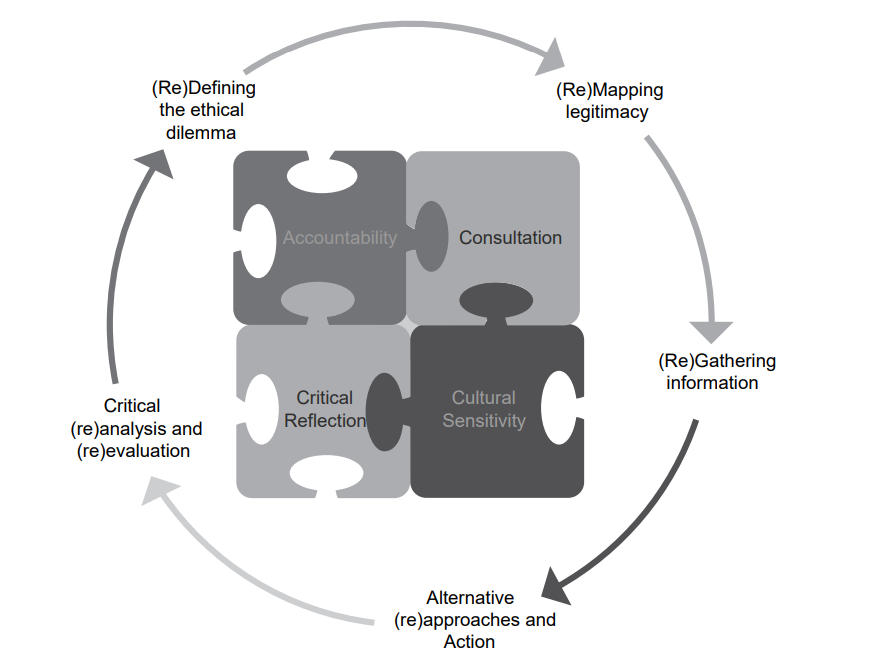
Accountability is about being open, transparent and honest, and therefore links closely to another foundation platform. The focus of accountability is on the ability of the worker to clearly articulate and justify decisions made, while taking into account the broader social context in which they operate.
Critical Reflection urges practitioners to open up their decision making to scrutiny by self and others in a way that will lead to better future practice.
Cultural Sensitivity is a necessary inclusion in the postmodern world where respect for the worldviews of others is paramount. Practice that is not culturally sensitive can leave workers open to claims of discrimination and can have devastating results if actions are taken that circumvent appropriate cultural responses or ignore important cultural norms.
Consultation is the action of using the wisdom and counsel of others wisely and engaging in discussions with others who may assist the practitioner in upholding important values in the interests of integrity and prudence. Consultation is an often neglected part of ethical decision-making, and many practitioners shoulder complex ethical burdens in silence for fear of being seen by colleagues as ‘unprofessional’ or ‘indecisive.’
Step One: Defining the Ethical Dilemma
Defining competing principles may require assistance from someone with ethical expertise in the particular situation, or there might be a need for legal advice. The questions that should be asked in this early stage of defining the ethical dilemma include:
- Can I clearly define competing ethical principles in this situation? If so, what are they? If not, do I need to consult with an appropriate other to clarify my thoughts? Are issues of culture involved here? (consultation; cultural sensitivity)
- If I determine that this is an ethical dilemma, where am I placed within it? Is it my role to make a decision, or should this situation be referred to someone with higher authority? (accountability)
- Is this situation familiar to me or do I need new knowledge? Can I draw on past experience or on what I have learnt from work in other contexts? (critical reflection)
Step Two: Mapping Legitimacy
An important part of good practice is the ability to conduct a thorough assessment of a situation and determine the nature of relationships of those involved at various levels of interpersonal, family and community systems.
Ethical dilemmas can involve many people, and it is not easy to decide who has a legitimate place in the decision-making process.
- Who has legitimacy in this situation? Who is included and who is excluded? Are there any cultural factors to take into account (e.g., extended family or kin in the case of indigenous clients)? (cultural sensitivity)
- Is it appropriate to share this ethical dilemma with others? Is this an ethical dilemma that I am facing alone, or are others also involved? Who should be talking to whom at this stage? (consultation; accountability; critical reflection)
Step Three: Gathering Information
The extent of information gathering will depend on familiarity with the situation, the ability to access resources in a timely manner and the availability of people who can provide necessary information. Some questions that can guide information gathering include:
- What guidance is provided by professional codes of ethics, protocols, policies or procedures, and are there any legal considerations? (accountability)
- Are there any conflicts between personal values, professional requirements and organizational mandates, and are these conflicts likely to present problems for the decision-maker or others? (critical reflection)
- Are there other resources that could shed light on this dilemma such as research, literature or the experiences of others? (consultation, critical reflection)
- Who could be consulted at this stage for the acquisition of new knowledge, or for clarification of positions taken by ethical codes, policies or law? (consultation)
- Is specific cultural knowledge required, and if so, who should be consulted for this? (cultural sensitivity
Step Four: Alternative Approaches and Action
The gathering of relevant information, and the discarding of the irrelevant, should result in a package of knowledge about the situation that can then be sorted and examined for potentially unhelpful or damaging outcomes, should a particular course of action be taken.
Should one be more concerned with relationships or good character (ethic of care, virtue ethics), then decisions might take a different course again. Some questions that can guide decision making at this stage include:
- What are the available courses of action now that I have gathered knowledge and information and considered the range of value positions? (accountability)
- On what basis will I make this decision and how will I justify my actions? (accountability)
- Am I missing other alternatives, and how can I be sure that I have weighed up all the options? Who can I talk to about this and can someone else play ‘devils advocate’ to help me clarify my position? (consultation)
- Are any of these options culturally discriminatory or insensitive? (cultural sensitivity)
- How do I feel about the decision I have come to, and is there anything I need to do differently? Can I live with this decision and can I justify it if called upon? How do I implement and document this decision? (critical reflection; accountability
Step Five: Critical Analysis and Evaluation
Making the time for critical reflection on practice will allow space for consideration of the impact of the decision-making process on self and others, and can shift what could have been a difficult and emotionally draining experience (as many ethical dilemmas turn out to be) into a more constructive learning experience. In critically analysing how a situation played itself out, a practitioner can move practice from a routinised and rote response to a more dynamic and thoughtful engagement with moral issues that lie at the heart of human services work. Who a practitioner chooses to consult also warrants scrutiny as it is always easier to share a difficult situation with someone who will be unlikely to offer a different or more challenging perspective. Some questions that can assist this process include:
- What have I learnt from this situation about the way I make decisions and have I changed my behaviour from previous decision-making patterns? (critical reflection)
- Do I feel confident that I acted in a culturally sensitive manner throughout the process or were there any aspects of culture that I neglected to explore? (cultural sensitivity
- Did I use consultation and support wisely, and who did I choose to talk with about the ethical dilemma? Were there others that I could or should have contacted for information? (consultation)
- Are there issues that I need to bring attention to in relation to deficits in organizational policies/procedures, ethical codes or other processes that impact negatively on service users? At the end of the day, can I own my decision confidently discuss my actions and take responsibility for my own part in the decision-making process? (accountability)
References
Ling, T. J., & Hauck, J. M. (2017). The ETHICS model: Comprehensive, ethical decision making. Vistas online. American Counseling Association.
McAuliffe, D., & Chenoweth, L. (2008). Leave no stone unturned: the inclusive model of ethical decision making. Ethics and Social Welfare, 2(1), 38-49, DOI: 10.1080/17496530801948739