
Confidentiality
Confidentiality
The most common reason a mental health professional received a complaint from 2003 – 2007 in Australia was a breach of confidentiality followed by a rude/ intensive manner (Grenyer & Lewis, 2012). According to Section 90 of the Privacy Act 1988 (Cth), relief for breach of confidentiality may be obtained in legal proceedings. Breaches of confidentiality can result in legal actions being taken against you for damages. It can also result in disciplinary action from within the professional bodies. We are all very well-versed in the importance of confidentiality in the therapeutic space, so why is it so difficult for therapists to maintain confidentiality, and why is it so common to breach it?
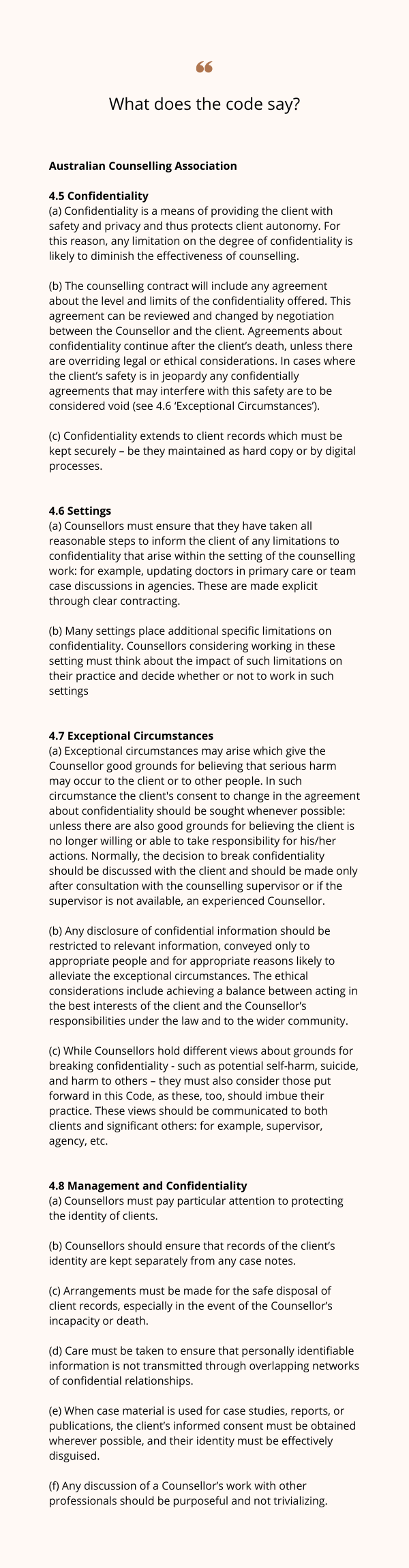
It is essential to be honest with yourself as we go through this list and reflect on any gaps or openings that you may find in your own practice. It is widespread for both health and mental health professionals to breech confidently. Especially amongst themselves or in settings where they think it is ‘safe’ such as with peers or other professionals who are also bound to confidentiality. Two statements relating to this particular situation in the ACA Code of Ethics (4.8 d and f) as it is quite common for health professionals to trivialise the client’s case as a source of gossip or entertainment.
Practitioners share information about patients for many reasons and in many contexts. They disclose client information in supervision, consultations and case presentations. When done properly, these disclosures benefit clients and improve clinical skills. They can be an essential part of growth as clinicians. Additionally, there are circumstances outside of formal relationships and contexts when disclosing information about clients serves a useful purpose.
Every clinician, at some point in his or her career, will struggle with managing intense feelings toward a patient or client, sometimes referred to as countertransference. Disclosing countertransference (which might manifest as frustration, romantic feelings, laughter, sadness, joy and elation) to a college or peer can also be supportive in processing your own reactions to clients. Discussing countertransference respectfully in a safe space where the client’s identity is protected can support the practitioner in not projecting their feelings onto your client.
The difference between case consultation and gossip
Dr Stephen Behnke (2007) illustrates the difference between a supportive conversation and gossip, outlined in the points below:
First, in these sorts of communications, the client’s identity is almost always irrelevant–the communication is about a dynamic or the clinician’s experience rather than any person’s identity. Who the client is isn’t important. With gossip, identity is very often central. Communications shared with individuals who know the patient’s identity often veer more toward gossip and risk exposing the client without any reasonable expectation of benefit other than their own self-gratification and elation of having a good story to tell.
Second, communications with a legitimate purpose are made professional to professional–that’s the point. The communication is to another trained clinician who has a context and expertise that allows the recipient to hear the material and respond in a particular way. Gossip often happens in the presence of non-clinicians or, even when made to a clinician, the identity of the recipient as a clinician is not particularly relevant to the communication.
Third, communications with a clinical or professional purpose or utility generate one set of feelings in the recipient. Gossip generates another. The recipient of gossip may be titillated, feel special or may wish the author of the gossip to stop talking about the patient in this manner or altogether. In the other instance, the recipient will hear the communication as primarily about the treatment or the clinician’s experience, not about the person of the patient, which allows for and promotes a different kind of response, ideally one that will benefit the treatment.
Fourth, space and time can be revealing. Social gatherings and public places, such as restaurants, provide relaxed atmospheres where work is set aside, especially in the evening hours. These settings invite gossip, which is a common human social activity. The likelihood that mention of a client will quickly devolve into gossip rises dramatically when we move away from work-related contexts and working hours.
The feeling of gossip also stimulates the practitioner into an elated state where they enjoy intruding on the private lives of the client with no clinical purpose. Gossiping about the other person produces a smugness and a satisfying pleasure; people are often drawn to a ‘good story’, and there are whole industries (journalism and film) capitalising on people getting off on drama. Often used as a tool of downward comparison, gossip can make the practitioner feel better about their own life or increase standing or favour with another person. No matter the reason why someone may gossip – it is always harmful and misrepresents the other person.
Gossip is destructive; It exploits the client and attempts to recruit others into colluding with the malaise act. It exploits the willingness of clients to share intimate aspects of their lives and their deepest thoughts. If you notice that you are affected by gossip, it is important to ask yourself why you are engaging in such things and what you are getting out of it.
The distinction between the two categories of communication is not always entirely clear. When uncertain, it can be helpful to ask, “Why am I sharing this particular information about this patient with this person?” Hesitation over whether we would be willing to share our response to these questions with our patient or a colleague whom we respect where the need to arise can be a sign that we are closer to gossip than we’d likely prefer. Treating patient communications with care is a way of showing respect. Gossip is careless.
Growing to be able to hold it all
Being able to hold everyone’s secrets, especially in a regional area where everyone knows everyone and often clients will talk about one another, can be challenging at times. You can feel like there is just too much that you are holding in the vault, and sometimes, this is why we let things slip or break confidentiality for relief. Often, we can tell our partners or other colleagues about who we are seeing and for what issues, but this is also classed as gossip and very harmful to the patient. Below are some guidelines about how to maintain confidentiality with clients and grow your capacity to be able to hold all the secrets.
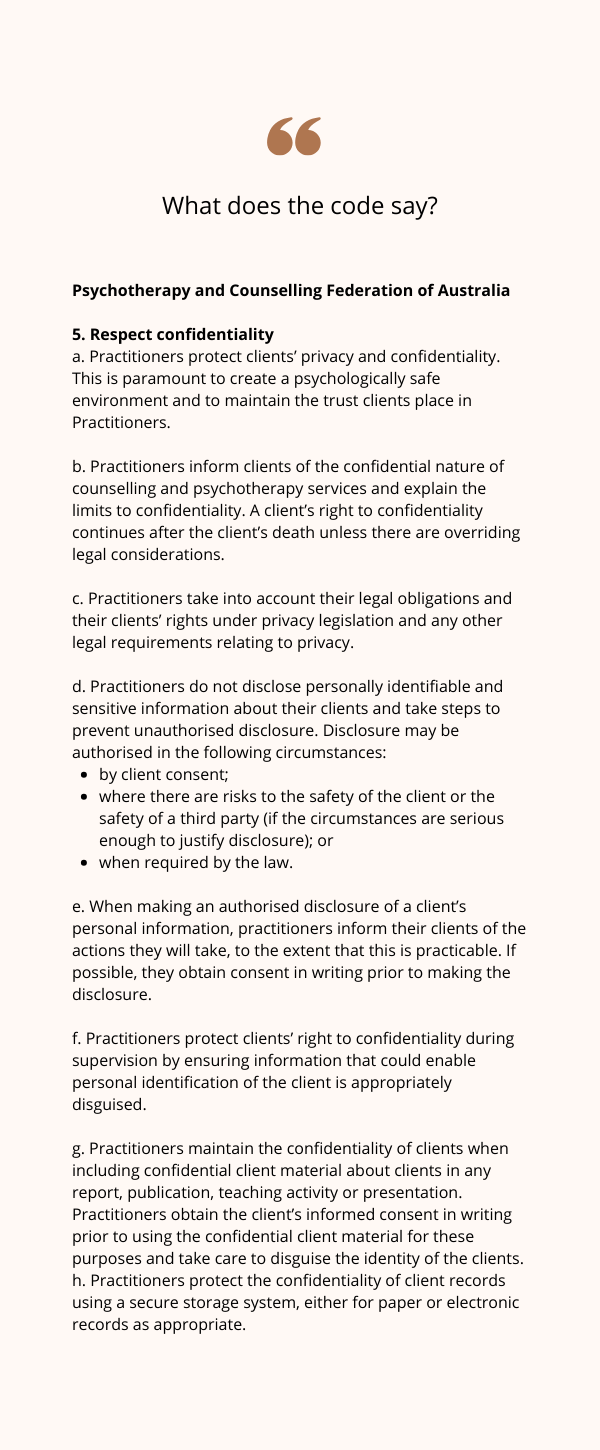
Therapists should remember that any disclosure in breach of patient confidentiality will only be lawful if it is authorised by the patient or by the law.
If they are not in the case, then they should not have the key
- As a general rule, if the other clinician is not directly involved in the case and you do not have written permission from the client to discuss their case with the other professionals, then it is a no-go zone.
- You can have a disclosure in your initial client consent form that states that you may talk about the client’s case with your supervisor or other healthcare professionals who are directly involved in the case with the client’s permission to do so.
- This means not talking about it with your partner, friends, colleagues and anyone who is not directly involved in the client’s care. They should not even know that you are seeing that particular person.
Always document consent to breach confidentiality
- When consulting a client, if you feel like you need to add in the plan the client’s GP or another health care professional, carefully document the consent with statements like “Client gave verbal consent for case consultation with GP”
- If you already have it as a section in your consent form, it is still important to gain verbal or written consent from the client before breaking confidentiality.
Talk to your supervisor about breaking confidentiality
- If you find yourself in an exceptional circumstance where the client or someone else is at risk of harm it is always good practice to consult your supervisor and document your reasoning before making a decision
- You can use an Ethical Decision Model (in later lessons) to support documentation and formulation of the reasons why you feel the need to break confidentiality.
This is not an easy area. Clients expect full confidence but therapists cannot hold this line where life and limb are at risk. Think carefully, take advice and record your reasons.
References
Behnke, S. (2007, May 1). Ethics Rounds–Gossiping about patients. Monitor on Psychology, 38(5). https://www.apa.org/monitor/may07/ethics