
Integrty and Responsibility
As a professional in the field of therapy, it is essential to understand the duty of care and responsibility that comes with helping individuals on their healing journey. While it is not our job to heal another person, it is our role to guide and facilitate their journey, providing a safe and unbiased space for them to explore their emotions and experiences. Unfortunately, harmful practices by practitioners of counselling and psychotherapy can occur, intentional or not, resulting in adverse consequences for the client. In this lesson, we will explore the different ways practitioners can cause harm to their clients and the importance of being aware of our own biases to maintain a safe and uncontaminated space for healing.
Many different types of harmful behaviours can occur in a therapeutic setting, and unfortunately, they occur intentionally and unintentionally all the time. This can be because of the gaps in training from educational settings around the practical elements of treatment planning, case notes, and report writing. Still, ultimately, it comes down to the therapist’s integrity and level of care. If a therapist truly understands the duty of care and the responsibility they have to keep the client safe, they will be much less likely to produce a behaviour that would constitute misconduct.
Duty of care is not just about what you do, it is also about what you don’t do. As professionals, it is not our job to heal anyone, you can not heal another person; it is their responsibility to heal themselves. If you are invested in the outcome of a client, this will contaminate the space that you hold and impose upon them your wishes for them to heal, rather than discerning what they are ready for in that moment. As therapists, it is our job to guide and facilitate their healing journey – not do it for them. You present what is there to be said for that particular client, confirm their steps but do not invest in an outcome. If you are identified by your clients success, you will also be crushed by their failures and take on the burden of their issues. When you take on your clients issues, it is impossible not to become overwhelmed and burnt out by the sheer weight of all that you are holding.
Healing is the ability to discard what has been done to you so that all that is left is who you are. As therapists, our role is to facilitate the clients journey of unpicking, unpacking and dissing the guard of protection that they have built around them to feel safe in the world. It is to see underneath all the tension and avoidance and support them to slow down and feel what they may have been avoiding or did not feel safe enough to feel. To do that, we must create a safe space for them to be held in, one that is free of bias, advice, judgment and projection of our own ideals and beliefs.
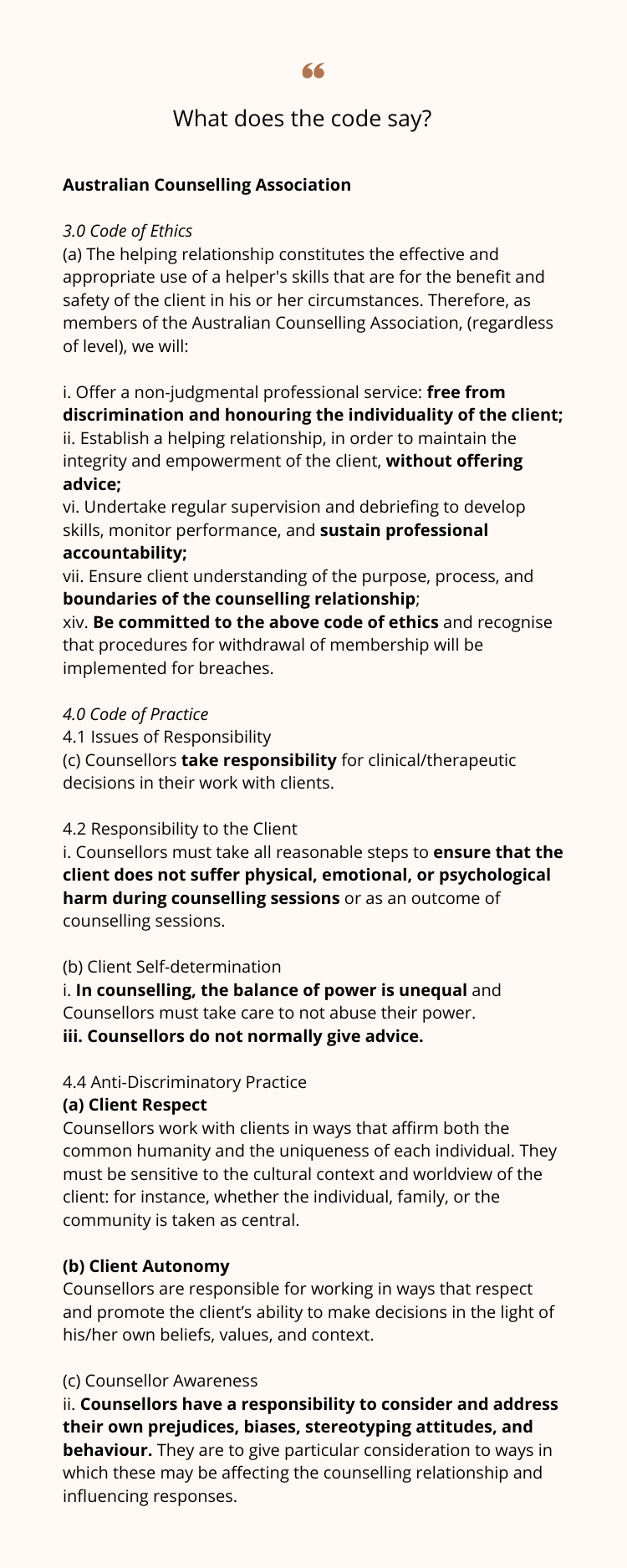
It is essential that as professionals, we, too, discard all that does not belong to us and be aware of our own biases and things that get in the way of being able to hold a clean and uncontaminated space to support the facilitation of the client’s healing journey. This is essential not only to keep ourselves safe as practitioners but also to protect our clients from harm. Below are some of the ways in which practitioners have been found to cause harm to clients (Sauvage, 2013).
Types of Harmful Practices by Practitioners of Counselling Psychotherapy and Casework
- Illegal activity which harms a client (including assault, paedophilia)
- Boundary transgressions, violations and abuse of trust, including sexual involvement; verbally sexualising or romanticising therapy; financial dealings; dual relationships; use of inappropriate touch; personal disclosure issues.
- Psychological exploitation including cult-like techniques and ‘mind control’, or those involving pseudo-spiritual ideas and ‘magical thinking’ where the therapist imposes a distorted view of reality from an expert position; psychological grooming for dependency and exploitation financially, psychologically, emotionally, spiritually, or sexually; use of expert position to invade clients capacity for boundary setting, to use authority to unreasonably direct clients’ major life decisions.
- Unclear or non-existent contracting about limits of service or expected outcomes; over servicing or under servicing; failure to provide grievance or restitution procedures.
- Lack of thorough assessment, effective intervention, or referral
- Contravention of clients’ rights to confidentiality, poor or inaccurate reporting or note-taking.
- Practitioner impairment, workload stressors, burnout, moral distress
- Dominance of therapists’ values, beliefs, advice, or method of therapy in a manner that is disempowering or harmful for the client.
- ‘Empirically’ unproven or questionable methods without a clear evidence base, lack of knowledge of neuroscience, trauma and mental health-specific issues.
- Problematic approaches to transference and counter-transference.
- Mismanagement of ‘therapeutic alliance ruptures’ and ‘termination’.
- Distant, cold, unengaged manner, lacking in human quality.
The side effects of psychotherapy are not confined to positive results and can include anxiety, depression, dependency, regression and depersonalisation. When there have been boundary violations, it is common for patients to describe symptoms of post-traumatic stress disorder, suicidal ideation and suicide attempts; completed suicide also occurs (Resnik, 2016). Other adverse consequences range from ineffective use of time and money to relationship breakdown, as the release of previously repressed effects and memories causes the patient to act out. Secondary harm may also be caused to the patient’s family in such circumstances. There are serious life-altering consequences for clients if therapists do not acknowledge and take seriously their role and the innate power imbalance that comes with it. There will be more about the therapeutic power imbalance in the next section (Hook & Devereux, 2018)
In conclusion, as professionals in the field of therapy, it is our responsibility to maintain integrity and responsibility towards our clients. We must create a safe and unbiased space for our clients to explore their emotions and experiences without imposing our own beliefs and values upon them. Harmful practices by practitioners of counselling and psychotherapy can occur, intentional or not, resulting in adverse consequences for the client. Therefore, it is crucial to be aware of our own biases and work towards maintaining a clean and uncontaminated space for our clients to facilitate their healing journey. By doing so, we not only protect our clients from harm but also keep ourselves safe as practitioners.
References:
Hook, J., & Devereux, D. (2018). Boundary violations in therapy: the patient’s experience of harm. BJPsych Advances, 24(6), 366–373. doi:10.1192/bja.2018.26
Sauvage, D. (2013). Experiences of Complaints about Counselling, Psychotherapy and Casework: Voicing the Need for Accountability and Care. Griffith University. Doi: https://doi.org/10.25904/1912/72
Resnik, S (2016) The Logics of Madness: On Infantile and Delusional Transference. Karnac Books.