
Boundry Violations
Boundary Violations

How common is sexual attraction towards clients? One might think that it will never happen to them and that they are above such things but in reality, chances are you will be sexually attracted to a client at some point in your career. Giovazolias and Davis (2001) found that only 22% of counselling psychologists had NEVER had romantic feelings towards a client before. That means that 78% of respondents had romantic feelings towards a client at some point. It is extremely important that you know what to do in these situations because it is highly likely that you might find yourself in a situation like this one day.
Not only is it more common than we would all like to admit, but it is considered one of the most serious complaints and leads to disciplinary action. In another study it was revealed taht 22% of responding psychologists had treated clinets who had been sexually involved with another therapist and almost 60% had traeted clinents who had repoerted non-sexual boundary violations. These violations included social activities, employment, and financial arrangements.
Why does it happen?
Jenks and Oka (2021) explain that transference refers to feelings, romantic or not, that a client has for another person, which are transferred onto a clinician. Countertransference, on the other hand, refers to feelings a clinician has being transferred onto a client.
While therapists with clear boundaries may sometimes experience transference or countertransference, these phenomena can lead to ethical breaches when combined with unclear boundaries. The lack of clear boundaries doesn’t always result in inappropriate intimacy between therapists and clients. There may be other factors that influence the decision to violate ethical norms and guidelines. Nonetheless, sexual relationships between therapists and clients have been a prevalent issue in therapeutic professions ever since individuals started seeking professional psychological assistance.
Therapy often provides clients a space where they’re truly listened to and comprehended, possibly for the first or after a long while. This can spark intense emotions that clients might associate with romantic sentiments, leading to erotic or romantic transference. It’s not just clients who might develop romantic feelings – therapists too can experience this due to the unique power dynamics in the therapeutic relationship where they are seen as authorities and close confidants.
Potential Risk Factors
Below are some of the potential risk factors that might lead to accidentally encouraging feelings of transference and leading on your clients.
- Not conferring with other therapists
- Being professionally isolated
- Overuse of self-disclosure and getting too personal with your own life. This blurs the boundaries of the relationship and creates a sense of familiarity.
- Accepting gifts from clients
- Using your personal phone number as a business number
- Contact outside of session times
- Being too readily available to contact, replying to text messages, and taking phonecalls outside of professional communication such as booking sessions
- Disclosing your own feelings to the client
- Situational factors or life crises e.g., relationship problems, divorce, illness, death of a loved one, financial problems
- Complex prior relationships and ineffective management of one’s own mental health problems
- Therapist substance abuse
- Unmet and unattended personal needs
- Dissatisfaction in the therapist’s own romantic relationships
- Thinking that it won’t happen to you and that you are above such things
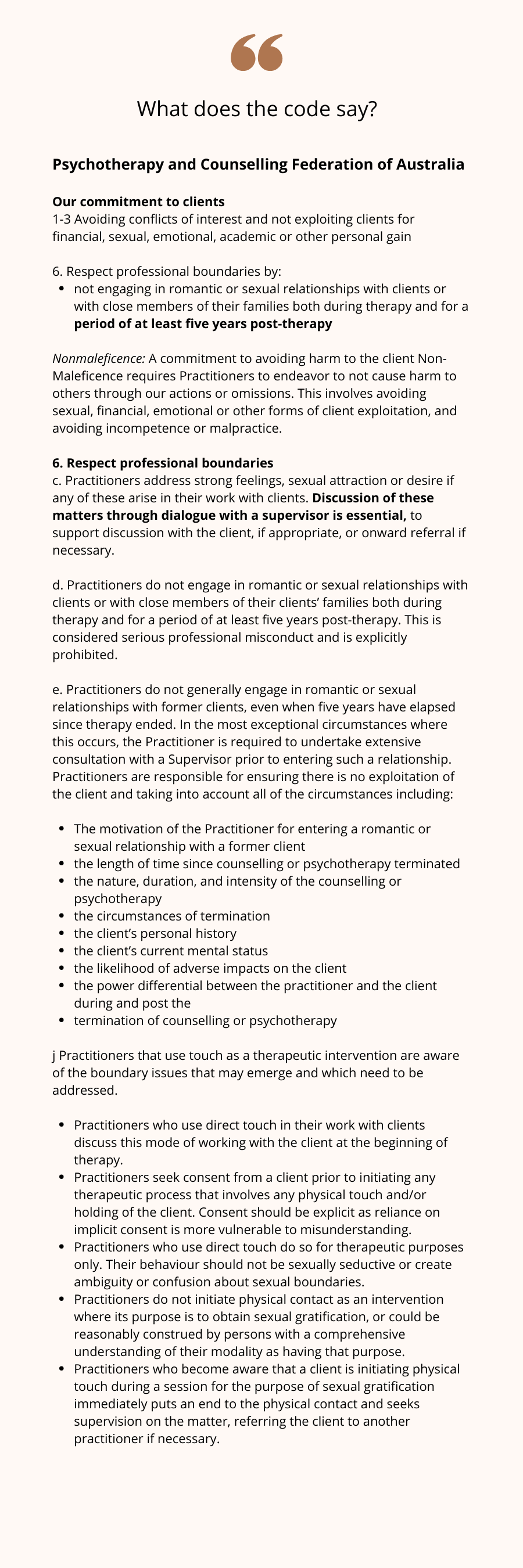
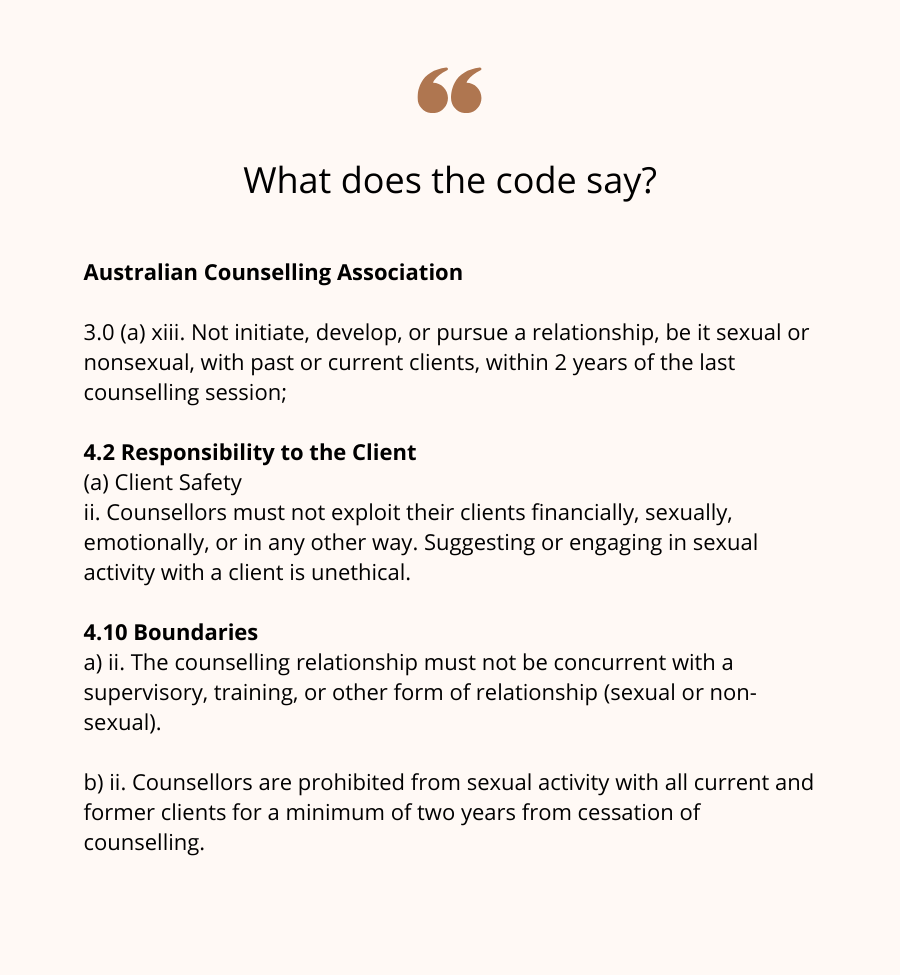
What can we do about it?
Handling transference
Boundaries are essential to forming an appropriate therapeutic relationship. It is important to recognise the potential impact that the therapist has on transference and how sometimes a client’s sexual transference can be brought on due to past experiences that are either triggered or resolved in therapy. If a client brings up romanticised or sexualised feelings for a therapist, it presents a valuable opportunity to discuss and reinforce the boundaries that are placed in therapy.
You can support the client in seeing that it is not you that they are falling in love with; it is the space created for them, for they do not know you outside of this professional relationship. You can normalise the experience for the clinician, saying it is common for clinicians to feel confused about the nature of the therapeutic relationship as they feel so good around you because you are listening to them and feeling free to be themselves. They are getting to know themselves and falling in love with how they feel around you and who they are, not necessarily you as a person.
It is also important to reiterate that it is against professional standards to have a romantic relationship with a client and that it is strictly prohibited. If appropriate, you can also detail the fact that even if a client has a relationship with a therapist, it is most likely doomed to fail as there is an innate power imbalance in the relationship and the client has the practitioner on a pedal stool and when the reality hits that they are not perfect, their picture is smashed, and the relationship eventually fails.
In summary, the therapist can take that opportunity to gently explore where the client feels their feelings are coming from, as well as discuss the limitations of their role as the therapist. It is best to confront the issue head-on as soon as the issue arises.
In doing so, the therapist can avoid potentially embarrassing the client or even causing the client to believe that sexuality is taboo and is not appropriate even outside of therapy. It is not necessary to react to romantic feelings from a client by withdrawing from the nurturing role. By setting a boundary and establishing the role of the therapist as a “nonsexual caregiver” therapist can create a safe environment to assist the client in working through the emotions that have come up (Jenks & Oka, 2021).
If a therapist considers client attraction as a barrier to therapy, they must determine whether it is necessary to refer the client elsewhere due to romantic transference or countertransference. Addressing concerns within the therapeutic relationship and working through issues that arise during therapy is often the key to breakthroughs and should not be feared. This is the case only when there are no reciprocal feelings towards the client – that is an entirely different matter, and we will get to that point later. If the feelings are purely one sided (clinet towards the therapist) than it is safe to explore these feelings in therapy. Suddenly ending therapy because of things discussed in therapy can cause clients to feel embarrassed and abandoned and may affect their decision to continue receiving therapy
Handling Countertransference (romantic feelings towards the client)
The Steps:
1. Acknowledging feelings
- First things first. You need to recognise and acknowledge the feelings within yourself and be prepared to feel them. They are there – ignoring them will not make them go away and can lead to things getting out of hand.
2. Seeking supervision
- Go to your supervisor and disclose what is going on for you. If you do not have a supervisor that you feel safe disclosing such things with, get another supervisor or find a personal therapist or mentor who knows what they are doing. Not conferring with other therapists and/or being isolated in practice are two of the highest risk factors for committing ethical violations. You should feel safe, held, supported and backed by your supervisor. This is someone that you will have a relationship with and be investing in for a long time. Be sure that they are the right one for you.
3. Reinforcing boundaries and potential to do harm
- If you find that you have violated boundaries in some way or another with the client, be sure to establish them. For example, you could apologise for giving out your phone numbers in the first place and ask that all calls, even crisis ones, be directed to your office number. If you have accepted gifts, you can return them and apologise for accepting them in the first place by explaining that it was unethical to do so. If you find yourself over-disclosing personal information, be sure to stop this behaviour and discontinue sharing details of your own private life. By having these discussions you can reinforce boundaries within yourself.
- DO NOT SELF-DISCOLSE FEELINGS. I repeat. Do not disclose to the client how you are feeling towards them. Unlike dealing with transference; it is not safe to bring your feelings into the therapeutic relationship. It creates a casual relationship and can give them the wrong idea. Clients should not be informed of the therapists’ romantic feelings in order to preserve the nature of the therapeutic relationship in therapy. By notifying clients of sexual feelings, a therapist starts to unknowingly harm the client and place undue pressure or stress on them. Through that experience, the client begins to lose trust in the therapist and no longer recognises them as an ally in their recovery process. Also, if romantic feelings for a client are brought up by the therapist and the client feels similar feelings, the door is open for a myriad of unethical issues that could result in disciplinary actions. Therapists need to be able to provide therapy services professionally and appropriately while still seeking guidance elsewhere. If at any time a therapist is confused or struggling to process a situation that happened in therapy, a supervisor or other mentor is a valuable resource to help them work through a decision-making model that will help them come to an appropriate decision (Jenks & Oka, 2021).
4. Referring out or not
Referring a client out can be a difficult decision to make in therapy. On one hand, referring out could provide the therapist with a way to avoid the uncomfortable conversation regarding misplaced feelings but could also cause the client to feel that they could no longer trust a therapist, create abandonment issues and avoid being transparent about their feelings. In any case, referring out should not be done until the therapist consults with another professional in order to see all perspectives and potential ramifications of the decision.
If a therapist does decide to refer out, some of the issues that would arise include what they would tell the client about why they were referring them out and what the risks/benefits would be of referring to another therapist. Again, this conversation needs to be had with a supervisor and potentially explored in some roleplays to support practising the conversation.
5. Self-care and education
Self-care can be a very helpful resource for a therapist working through a difficult situation. For example, educating yourself regarding working with clients with diagnoses such as personality disorders and recognizing the importance of placing boundaries for yourself and in therapy in order to ensure that therapy stays a safe environment. You may want to come up with certain techniques that you can use to check yourself in therapy to realise when you might be unintentionally going down a path that could lead to a difficult situation.
Additionally, if working with a client unearths issues relating to your own relationships or personal history it is important to address these issues. Self-care may include individual or couples therapy to support you in working through the challenges in your relationship. Furthermore addressing any communication issues in your personal life with partners and friends so that you feel fulfilled in relationships outside of the therapeutic relationship so that you do not seek fulfilment from clients.
To reinforce important steps to take, a therapist who is found in a situation similar to what was previously described should take account of and recognise the feelings that were expressed in therapy whether by the client or the therapist. This step may help the therapist better know how to handle the situation ethically. The next step of seeking supervision or advice will help the therapist to further identify what the most ethical course of action should be, including reinforcing boundaries while recognising the importance of doing no harm and the importance of self-care and education. Ultimately, a therapist should always be aware of the impact of therapeutic choices on their client’s wellbeing and strive to consistently provide ethically minded services that ensure the safety of everyone involved.
References
Giovazolias, Theodoros & Davis, Paul. (2001). How common is sexual attraction toward clients? The experiences of sexual attraction of counselling psychologists toward their clients and its impact on the therapeutic process. Counselling Psychology Quarterly. 14. 281-286. 10.1080/09515070110100974.
Jenks, D. B., & Oka, M. (2021). Breaking hearts: Ethically handling transference and countertransference in therapy. American Journal of Family Therapy, 49(5), 443–460. https://doi.org/10.1080/01926187.2020.1830732